



As a mum, have you ever looked back at your day and wondered what you have filled it with? When listed out, the practical things (changing nappies, feeding your baby) may not seem like a lot. But underneath the practicalities, there is something that you’re continually doing: helping your child to learn how to regulate their emotions.
Self-regulation is the ability to manage our behaviours, thoughts, emotions, and impulses without relying on external sources like other people, food, or alcohol. It’s what helps us pause before snapping in frustration, or allows a child to begin calming themselves after becoming upset.
In this article, we’ll explore the vital, and often invisible, emotional work mothers do to support their baby’s developing ability to self-regulate. We’ll also look at how our own childhood experiences can make this work more challenging, and we’ll cover practical ways you can build your own emotional regulation skills so you can reduce your distress and nurture your child’s emotional resilience.
When Facing Your Emotions Feels Too Much
You might find yourself sitting with some discomfort as you begin to notice how you’re struggling to regulate your own emotions or to support your child in regulating theirs. That discomfort can make it tempting to turn away and avoid the situation. But I invite you to stay with me.
Often, this kind of discomfort brings up shame. Shame tells us we’re wrong in some way and urges us to hide. But avoiding what’s painful doesn’t make it disappear. In fact, shame can trap us in a cycle of silence and secrecy that makes change feel even further out of reach.
It’s important to understand that your difficulties with emotional regulation are not your fault. They’re shaped by the experiences you’ve lived through, especially those in your early years. And although it’s not your fault, the fact that you’re here reading this tells me you’re hoping for something to change. That’s where self-compassion comes in.
Self-compassion means offering yourself the same warmth and understanding you’d give to someone you love, if they were in your shoes. It doesn’t excuse difficulties, but it helps us stay open to them without judgment so that we can learn, grow, and move forward. I post a lot on social media about developing self-compassion as a mum if you think that would be valuable for you.
The emotional work of motherhood
Babies are not born with the ability to self-regulate so they require their caregiver to support them in this process. Through countless everyday interactions, your baby begins to understand their emotional world. When you mirror their emotions, this enables them to learn about their emotions. And when you support them in regulating their emotions, they start to learn how to soothe themselves.
But this process takes energy, skill, and time. And lots of it.
So, in an everyday interaction, what does this look like? It might go something like this:
- Your child has a big emotion- maybe they’re crying intensely.
- This naturally brings up potentially challenging emotions and memories for you.
- You try to stay grounded so you don’t become overwhelmed.
- You try to tune into your child to understand their emotions and needs.
- You try to identify and remove any sources of distress.
- Then, you help your baby calm. Perhaps by rocking, holding, touching, stroking, or using a soothing voice.
This is ongoing, demanding, emotional work. And let’s be real: none of us are getting it right all the time.

Why self-regulation is even harder for some of us
This already demanding emotional work can be even harder if you grew up with a caregiver who wasn’t emotionally available to you. Our early relationships shape how our brain develops. In the first two years of life, our ability to self-regulate is formed through connection with caregivers who are warm, responsive, and emotionally available. Without this kind of support, we may grow into adulthood with fewer tools for emotional regulation.
And it’s not just about early relationships. If we’ve experienced situations where we’ve felt powerless or unsafe at any point in our lives, these experiences can leave a lasting imprint. They can make it difficult to stay grounded in the present moment, especially when we’re faced with situations which make our emotions run high.
It can bring up a lot of emotion for people realising that their past painful experiences may still be impacting them today. But also to say that our brains are capable of change and we can develop our ability for emotional regulation.
Becoming aware of our emotional world
The first step in developing emotional regulation is learning to notice what we’re experiencing in the moment. When emotions run high, they can easily overwhelm us and cause us to react without thinking. But the more we practise noticing what’s happening inside us, the more we create space between what we feel and how we respond.
Over time, we can also begin to recognise patterns. We may notice that certain situations tend to trigger certain emotional responses within us. This awareness gives us the chance to make changes: whether that’s considering ways to prevent these situations from occurring or to develop skills to better manage them when they do occur.
Of course, this process often doesn’t come easily. Especially if you’ve been taught to ignore or suppress emotions. Tuning into your inner world takes practice. You might start by pausing at different points in your day to check in with yourself. What are you feeling in your body? Maybe there’s a tight chest, a clenched jaw, or a heavy feeling in your stomach. What thoughts are coming up in your mind?
You can try to label the experience as best you can, even something as simple as “tense” or “sad.” Over time, you’ll likely become more precise. An emotions wheel (like the one below) can be a helpful tool for expanding your emotional vocabulary.
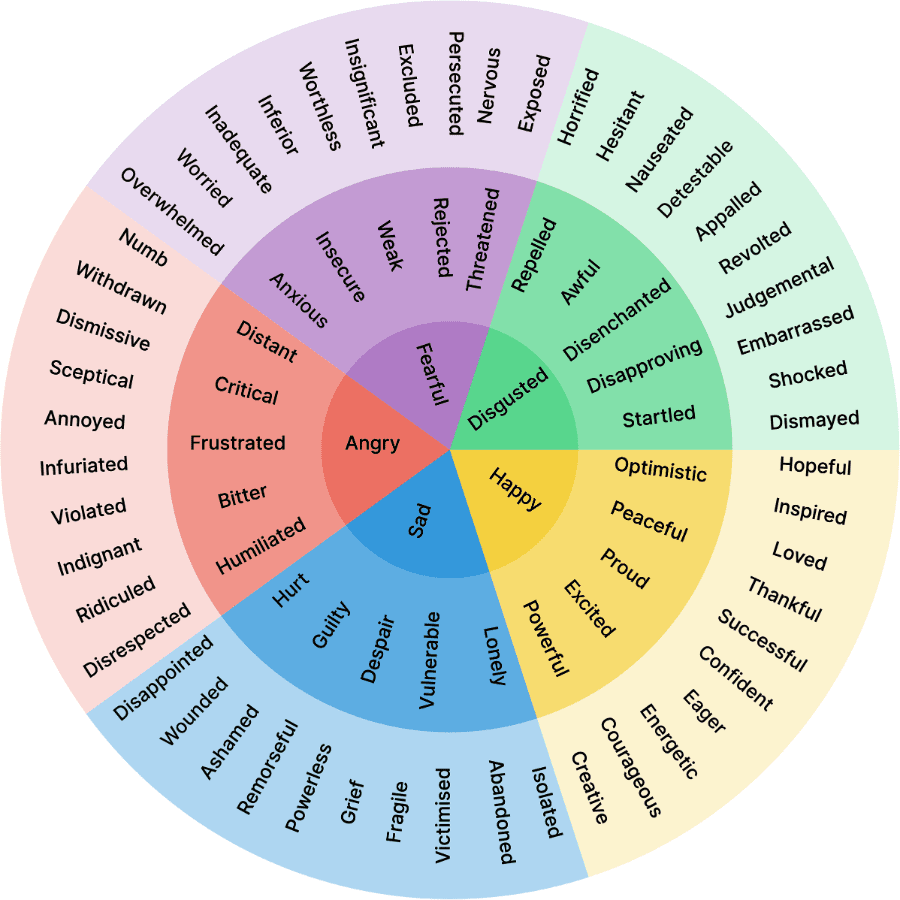
Therapy is also a great tool in helping you to develop more understanding of your emotions. Therapists are able to empathise with how you may be experiencing certain situations and offer their reflections to you. This can help to bring new things into your awareness so you can develop further understanding of your experiences.
Additionally, therapy can be a space where you can choose to reflect upon your past experiences and relationships. This can provide you with an insight of how these past experiences are impacting your current responses. This can be the starting point from which to make change.
Developing the ability to manage your emotions
Once you’re able to identify an emotion, you’re already creating space between what you’re feeling and how you respond. That space is powerful as it allows for choice. Over time, we can build the ability to sit with uncomfortable emotions without being overwhelmed by them. It’s not easy at first but the more we practise staying present with difficult feelings, the more confident and resilient we become. We begin to trust that we can tolerate discomfort, and that it will pass.
There are also tools we can use to help us experience our emotions without getting overwhelmed by them. One of those tools is grounding. Grounding techniques help bring you back to the present moment when emotions feel too intense. Finding a grounding practice that works for you might take some trial and error, but here are a few you may want to try to start with:
- The 5-4-3-2-1 method: This is a way of using your senses to anchor you. List 5 things you can see, 4 you can hear, 3 you can touch, 2 you can smell, and 1 you can taste.
- Deep breathing: Breathe deeply into your belly, and exhale slowly. Try silently saying “in” and “out” with each breath to keep your focus.
- Touch something comforting: This might be a soft blanket, a smooth stone, or a favourite piece of clothing. Focus on its texture and how it feels in your hand.
These are just a few grounding techniques, if you’d like more ideas, this article has a wider range of suggestions.
Developing the ability to sit with your emotions without becoming overwhelmed can be a challenging process and this is where therapy can offer valuable support along the way. Having someone there with you in those difficult moments can help you stay with the discomfort, rather than avoid or shut it down. In moments when your emotions feel overwhelming, a therapist can help you remember and implement strategies that might otherwise feel out of reach.
A therapist can also help you to address those automatic responses which you would prefer not to have. It may be that you find yourself automatically becoming angry or withdrawing. Often, we have developed these responses as a way of keeping ourselves safe during difficult times. But then we carry them forward with us when they are no longer needed. In therapy there is space to become more aware of these patterns, to process past painful experiences, and have the support to start moving towards new ways of responding, however unfamiliar and vulnerable that may feel.

Learning Emotional Connection Through Therapy
Therapy isn’t just about talking, it’s also about being in relationship. The relationship between therapist and client can become a space where emotional patterns begin to shift.
If you didn’t grow up with a caregiver who was consistently warm, responsive, and emotionally available, it can be hard to know what that kind of connection even feels like, let alone how to offer it to your child. But in therapy, you can begin to experience what it’s like to be emotionally attuned to, supported, and understood.
Over time, the therapeutic relationship can model what a secure, connected relationship looks and feels like, even when difficult emotions show up. And this experience can gently help you develop the emotional presence and responsiveness that you may want to bring into your relationship with your child.
Final thoughts
I want to close this article as I began, with a gentle reminder that perfection is not a realistic expectation. Speaking from my own experience, both as someone who has undergone years of personal therapy and trained to become a therapist, I don’t get this right all the time either. Breaking these cycles is difficult, ongoing work, and perfection isn’t the goal. Instead, practicing self-compassion and making steady, realistic progress is what truly matters. By reading this article and facing these challenging emotions, you’ve already taken an important step forward.
Motherhood is emotionally demanding work, and to support your child, it’s important for you to be supported too. Therapy can be a valuable part of that need. If you’d like to learn more about me and my approach, you can find out more here and here. I also offer a free, no-obligation 20-minute introduction call to discuss how I can support you. You can book that here.

Megan Baldry
I am a counsellor and psychotherapist who supports women with their mental health and wellbeing during pregnancy and motherhood.
I’m a BACP registered therapist with a masters degree in counselling and psychotherapy and specialist training in maternal mental health.
I offer sessions online and via phone in the UK. I offer regular and ad-hoc therapy sessions which are a space for you to be supported and work on goals that feel meaningful to you.
I also produce blogs and videos around therapy and the common challenges and transitions that come up in motherhood.


Share: